
Stay22 Review – Offering Novel Tools to Make More Travel Affiliate Money
Published by Jeremy. Last Updated on July 21, 2026.
Disclaimer: This Week in Blogging uses demographic data, email opt-ins, and affiliate links to operate this site. Please review our Terms and Conditions and Privacy Policy.
Published by Jeremy. Last Updated on July 21, 2026.
Disclaimer: This post contains sponsored content. This Week in Blogging uses demographic data, email opt-ins, and affiliate links to operate this site. Please review our Terms and Conditions and Privacy Policy. To see more of our content, set us as a Preferred Source in Google.
Stay22 has been taking the travel blogging world by storm in recent years, with bloggers flocking to the network to utilize their many services like consolidating deep links across many networks in one portal, generated maps with live hotel pricing, and their NOVA tool that targets readers who are planning trips.
I’ve been a user of Stay22 for several years now, with a lifetime affiliate revenue of $40,000+ as of July 2026, and it has been fascinating to see how this one has developed over time. With recent tools like NOVA, Spark, and more being added to the platform’s product lineup, my affiliate earnings are quickly racing towards matching my display advertising as my top income stream.
So in this one, we thought we’d share a few of our favorite features from Stay22, how to use them, ways to get the most out of the network, and, of course, how they’ve helped supercharge our affiliate earnings!
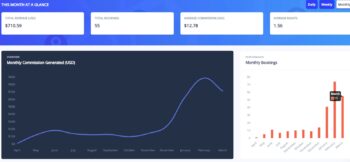
Note: This review is sponsored by Stay22; however, all opinions are our own. The booking data shown is my actual data without modification.
Buy Me a Coffee Review – A Source of Extra Blogging Income

Published by Chris. Last Updated on March 13, 2023.
Disclaimer: This Week in Blogging uses demographic data, email opt-ins, and affiliate links to operate this site. Please review our Terms and Conditions and Privacy Policy.
Buy Me a Coffee hails itself as “the best way for creators and artists to accept support and membership from their fans.” Today, we’re going to talk about whether that’s truly the case.
When we’re talking about memberships, Patreon is the first name that comes to mind, but Patreon really hasn’t figured out the “casual supporter” dilemma – ie. the reader or subscriber that might love what you’re doing, but doesn’t want to be locked in to a monthly subscription.
Buy Me a Coffee has made strides recently to become more membership focused, but at it’s core what makes it worth it for creators is that it’s a very easy method to give your audience a way to say thanks. As they note, “In just a couple of taps, your fans can make the payment (buy you a coffee) and leave a message. They don’t even have to create an account!”
Jeremy and I put a lot of time into This Week in Blogging and so we set up our own Buy Me a Coffee account (though you’ll notice that we went for the “Buy Me a Beer” option based on what we like sipping on!). Thus far, it’s been a fantastic way for us to not only bring in extra revenue to support the project, but also to hear from subscribers directly about the value they’re receiving.
Besides the income, which is both humbling and appreciated, the emotional boost that you get when a new supporter takes the time to throw a few bucks your way is immense, and that’s part of the reason we’re big fans.
Niche Product Sites Case Study #5 – Finding Momentum

Published by Jeremy. Last Updated on March 6, 2023.
Disclaimer: This Week in Blogging uses demographic data, email opt-ins, and affiliate links to operate this site. Please review our Terms and Conditions and Privacy Policy.
Welcome to the fifth entry into our niche product site case study series.
In this case study, we are tracking the performance of niche product sites I created between 2020 and 2022, what is working, what is not, income and traffic changes, and lessons learned along the way.
The first site we will look at is The Grape Pursuit, a wine blog I started in early 2020. The second site is Hipster Homesteaders, a home & garden plus food & beverage blog we started in late 2021 (where we merged two lagging product sites, a coffee blog and sous vide blog, into a broader umbrella branding to allow for more content to be produced with other topics).
In the last six months, the wine blog has started to find its footing and is gaining momentum with new ideas we are replicating at scale. The homestead site’s growth in traffic has been slow, but an uptick in affiliate sales is showing progress that we’re on the right path.
5 Blogging Business Models to Consider to Generate Revenue

Published by Jeremy. Last Updated on October 16, 2025.
Disclaimer: This Week in Blogging uses demographic data, email opt-ins, and affiliate links to operate this site. Please review our Terms and Conditions and Privacy Policy.
If you are thinking about starting a blog (perhaps a 2nd or 3rd blog), or run a site that is not monetized, you may be thinking the question we all have on our minds: how do I make money blogging?
While we will be the first to admit that there is no one-size-fits-all business model for blogs, as the field is truly quite versatile, when we stopped to think of it we realized there are five main models that blogs follow to earn revenue.
So in this one, we wanted to take a broad look at the most common business models blogs have, share some pros and cons of each, and explain why the best model of all may be doing a bit of everything!
Note: While income potentials vary, we will try and equate models with each other by using the Revenue per 1,000 impressions (RPM) term. While there is no hard and fast rule that Model [X] will always make RPM [Y], we will fill the gaps in with our experiences of what we have seen in the industry.
7 Essential Pages Every Blog Should Have

Published by Jeremy. Last Updated on February 20, 2023.
Disclaimer: This Week in Blogging uses demographic data, email opt-ins, and affiliate links to operate this site. Please review our Terms and Conditions and Privacy Policy.
If you are looking to start a new blog, the tasks you have to complete are often overwhelming. Setting up servers, WordPress, themes, plugins- the sky is really the limit and that is before you even create a single piece of content.
Once you are ready to start writing articles, you may need to take a few days to put together some pages that we consider to be essential for every blog to have.
So in this one, we thought we’d take a look at pages you should publish on your blog, why you need them, and brief discussions about what should be included in each.
Note: We discuss the pages below as must-have pages that should be linked within in a navigation menu, but do not discount having them in a navigation footer on your site as well. This way users can reach all of the required pages at the start and end of your site.