
Published by Jeremy. Last Updated on December 20, 2025.
Disclaimer: This Week in Blogging uses demographic data, email opt-ins, and affiliate links to operate this site. Please review our Terms and Conditions and Privacy Policy. To see more of our content, set us as a Preferred Source in Google.
When I decided to self-publish a book, my research into publishing companies led me to IngramSpark- often considered to be a gold standard in publishing.
As I was in a bit of crunch time to get my book out for the holidays, I leapt in headfirst and went all-in on the service.
While I would admit that I had a good experience with IngramSpark all around, there are some things I wish I had spent more time understanding ahead of time as it would’ve changed how I approached designing and releasing my book.
So if you’re looking to publish a book, don’t overlook these details!
Be Careful With Design Issues Like Bleed and Alignment
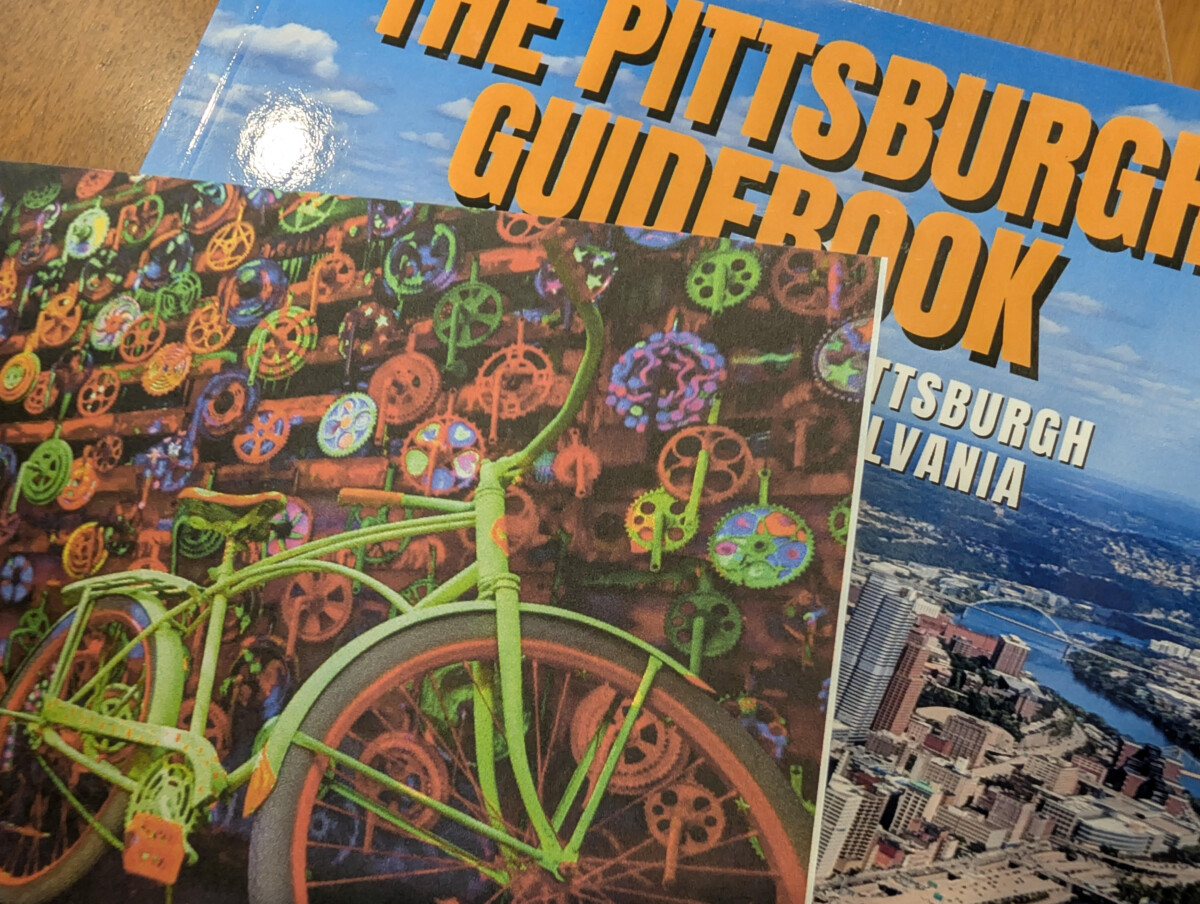
One minor issue I had when testing prints of my book was that IngramSpark’s proof didn’t catch some design issues I had, like needing extra bleed for full-width images.
While my proof digital looked fine, when I ordered a test print of my book at 6″x9″, I had visible white spaces along the side and top of the prints where my images were placed (visible in the photo above). I quickly realized that I did not account for bleed and had to adjust my page sizing and image layout. This was admittedly my fault, and I later found guidance buried in IngramSpark’s directory to that effect, which I had never noticed before.
Although bleed for full-width images is an issue you really need to account for on all publishing services, this bit of info felt a bit buried in the proofing process compared to other services that put it front and center. Even worse? If you don’t catch it until after publication, like I did, you may have to pay an extra fee for revising your files. Ouch.
In fact, other issues, like content distance from the spine and other alignment/readability concerns, are also not really highlighted in the design tools, so you will want to make sure that you account for these in your own design software, via test prints, and more.
- Note: If you use design services like Canva to build your PDF, it’s worth noting that document-wide size adjustments on Canva Pro are quite easy to use, but they’re not perfect. When I expanded my book size a little bit to make the pages a little larger for bleed, not every element on every page moved equally. For example, page numbers moved on some pages, but not others. To fix this, I picked an element and set an X, Y coordinate to align them on all pages (manually) and then moved other elements around with respect to that.
- I later found that other print services, like Amazon KDP, do a much better job at previewing your book for you with alignment concerns, bleed, and showing where other errors may exist to catch them at the start, which I really wish IngramSpark would integrate. I came up with similar logic for adjusting placements here, like alternating the X-axis alignment of page numbers on the spine side (alternating pages).
Wholesale and Distribution Fees Eat Into Profits
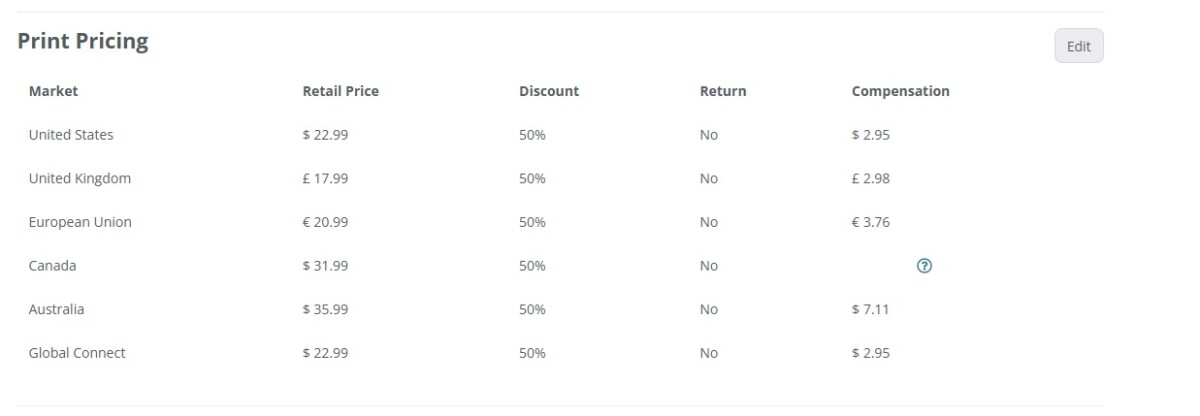
One element of IngramSpark that annoyed me when I first launched my book was that their wholesale discount portal is sparse on information. Really sparse.
For selling to bookstores on wholesale, they recommend a 50%+ discount off the list price in order to entice stores to buy. This makes sense- stores need to make a profit and are taking a risk holding inventory. I set my discount at 50%, which would still net me $3 in profit per book, sent out some emails to local stores about my wholesale offering, and thought that was that.
Well, shortly thereafter, a store emailed me back and asked why my discount was showing 36% off and not 50% off. Uhm, what? That’s news to me!
As it turns out, distributors appear to add on a fulfillment fee, which I perhaps naively thought was originally baked into my printing cost. From what I have since read, it seems like that is around 15% of the list price (not the discount price) for IngramSpark’s iPage- but your mileage may vary by book and other distributor partners that may source your book.
I only figured this out when trying to generate custom discount links on the e-commerce portal. My minimum order price was not my author rate, nor my wholesale rate, but roughly $3.50 more than my wholesale rate. At a $22.99 non-discounted retail price, this coincided with, you guessed it, a 15% distribution fee and a max discount of 36% off- just like what the bookstore was seeing.
Is there any part of the wholesale portal that suggests a fee is added after discount? Not that I can tell, and that’s a problem.
So when setting your wholesale price for stores, keep in mind that a fee will likely be added after your discounted price. It’s just a shame they don’t show this anywhere on the wholesale portal to give publishers a better indication of what price stores may see, as I would’ve changed my email outreach language accordingly.
- Note: This fee may vary depending on the portal a bookstore uses for wholesale. The extra price added above is likely reflective of Ingram Spark’s iPage only. Still, a caveat of “fees typically range from $X to $Y” would’ve been quite helpful to know upfront.
- I’ve since removed all numbers for discount percentages and just say I offer generous discounts when purchased on wholesale portals.
Wholesale Discounts Apply Everywhere
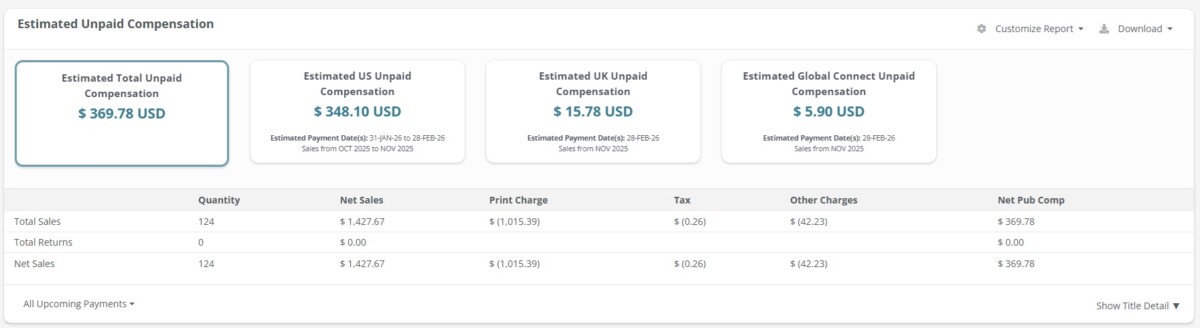
Another confusing element about IngramSpark was that your listed wholesale price is extended to seemingly every 3rd-party service, not just bookstores. This includes Amazon and other major retailers that fulfill print-on-demand orders on your behalf.
When reading about how Amazon pays commissions on books, I naively thought I would be receiving a higher commission since they order print-on-demand and aren’t necessarily pre-purchasing stock like a traditional wholesale retailer. The amount of work they do to facilitate a transaction doesn’t feel to be on the same scale as a bookstore taking risks and stocking its shelves.
When I got my first commission report, I realized all of my sales were for my wholesale rate only- even on Amazon. A measly $3 per book on a $22.99 list price with 50% discount was much less than what I was expecting. Meanwhile, if I fulfilled sales myself (which I have trouble doing since I travel a lot), I likely would be making nearly $10 per book. And if you like to do even more fun math, this means I would’ve had to sell 3-4 books before the profits let me buy just one for myself with tax and shipping.
Considering printing a book on Amazon KDP offers a much higher profit share (they take 40% of the list price, whereas they are taking 50% from my wholesale rate on IngramSpark), lower print prices (more on that below), and significantly faster ship times, I quickly realized that using IngramSpark to fulfill on Amazon may not be the best idea. Great for all other services, sure, but not Amazon, where I anticipated having the bulk of my orders thanks to their free shipping for Prime members.
So I quickly reformatted my book to print on Amazon, tested new prints, and will be using Amazon KDP for Amazon fulfillment and IngramSpark for the rest. I missed out on more money on the first 100 or so books ordered, but at least I caught it at 100 orders and not 1,000. I guess that is a little win with my book being a bit slower to launch than I wanted.
Suffice it to say, there is no way to separate pricing for individual services here, and that’s a problem in my opinion.
- Additional Considerations: When I went down the rabbit hole of this one, I read how some publishers do not offer significant wholesale discounts on IngramSpark, and instead just fulfill book orders to stores directly. This could be an option for those who think their sales will be predominantly online, as Amazon would likely stock your book regardless, since their required work is, as previously noted, minimal.
- I explicitly wanted bookstore sales for my city guidebook, as they likely would move considerable volume (and I really didn’t want to deal with facilitating orders myself), so naturally, keeping that discount percentage on IngramSpark was necessary for me. This created a problem for the 3rd-party orders on Amazon, as discussed above.
- It is worth noting that IngramSpark offers more print options than Amazon KDP. I was using a heavier paper weight on IngramSpark, which increased my cost, which I later found out that Amazon does not offer as a print option. This is likely one of the reasons my book’s cost is lower on Amazon. The quality isn’t quite as good as the tier I had originally printed on (the color was the same but you could see through to the next page just a bit more due to be a thinner page weight), but it was a sacrifice I was willing to make for a larger profit margin and faster shipping.
Long Lead Times Make Online Sales Harder
Another downside to IngramSpark is that the print-on-demand model lends itself to variable lead times.
When I launched my book in early November, books would print within 5 business days, and I could pay a premium to get a book printed and shipped the next day. Shipment was as fast as next day when printed from the closest facility, to 3-4 days or longer if printed elsewhere. As they did not seem to print and fulfill on weekends, this meant ordering later in the week could result in a run of books taking upwards of two weeks to deliver.
This was mostly fine when ordering books for myself, but it was not so great for competitive marketplaces like Amazon that were directly customer-facing and are known for next-day / same-week deliveries.
This only got worse closer to the holiday season, and I had to have my final sales in for Christmas by December 6th- missing a couple of weeks of possible orders had I been able to fulfill myself or via better models that had a faster turnaround time. Can I say that I lost any sales because of this? To be fair, no, I can’t. But also, as a customer, would I buy a book with a one to two week delivery timeline, especially as a last-minute gift? Also, absolutely not.
This also pushed me to move my Amazon KDP fulfillment to their print service while keeping all other offerings through IngramSpark. It also forced me to maintain a larger stock of books on hand for direct sales when I can fulfill myself- even if I really wasn’t prepared to front that kind of cash to maintain inventory.
- Local bookstores have told me my book was delivered much faster, on the order of a few days, which seems to be directly at odds with some of the lead times I see myself. I’m not sure if this implies that IngramSpark is giving wholesale stores priority, or if they’re just ordering enough volume to warrant faster shipment, but at least they’re not also having to wait a week-plus to receive my book. So there is a silver lining there.
Need Customer Service? Pay For It or Wait

Another issue I had with IngramSpark was that their customer service portal is incredibly lacking. They have what appears to be an AI chatbot, which is okay for basic queries; a paid portal for instant support (with 30 to 60 minutes of help), which is suitable for detailed publishing hand-holding concerns; and then a conventional contact form that took a week or more to hear back from another human, even for basic policy clarifications.
I had a question from a potential customer about bulk pricing for 2,000 books and asked the best method to order these (wholesale, direct fulfillment, etc.), and it took almost two weeks to get an email back with a generic discount form showing price breaks, while not really answering the intent of my question.
I understand that detailed formatting/book-specific questions are probably worth a consulting fee for time, but a long lead time to answer a simple ordering question (particularly when my order could’ve been nearly $20,000) feels like a hole in the service. The good news is that the sale is probably not going to come through for many months, but in another circumstance, I very much could’ve lost that order without knowing the answer promptly.
I ended up skipping wholesale services for that quote in favor of direct fulfillment, primarily to reduce the cost-per-print. But given that I wrote that solution in one minute, I also don’t think it should’ve taken almost two weeks to receive any form of clarification, either
So if you need assistance at IngramSpark, be prepared to pay for it, or wait for it.
Ultimately, IngramSpark is Not A One-Size-Fits-All Service
After launching my book on IngramSpark, I came to the conclusion that it isn’t a one-size-fits-all book publishing service, but rather, it is simply good (but perhaps not great) for two specific instances:
- Bulk orders, such as buying print copies for yourself for direct distribution/sale.
- Distribution for bookstores on wholesale, where stores buy and carry your books on your behalf, without you doing any work in the background.
- Bookstores I talked to really love IngramSpark (one went as far as saying “you’re already using Ingram, so you’re much further ahead from most authors”), and that cannot be overstated.
While the second has its drawbacks, as noted in this article, the real problem comes from using online retailers like Amazon, which simply facilitate book orders within the print-on-demand ecosystem. IngramSpark just doesn’t feel competitive here, and that’s a big drawback.
It is convenient to have everything in one place, but giving up more fees and long lead times to services that are simply passing an order through didn’t sit right with me- especially when Amazon can print and fulfill their own book orders much faster and at a larger profit share as well- albeit, perhaps at a slightly lower quality print overall in my case.
In these instances, I believe these online stores should not receive your wholesale rate, as they do not share any of the risk or maintain inventory as conventional stores do. They’re simply facilitating a transaction from customer to IngramSpark. So, this is why I am moving my book over to Amazon’s KDP service for fulfillment on Amazon directly, but will be staying on IngramSpark for everything else.
Yes, it really all comes down to money, and that’s all there is to it.
Have you used IngramSpark for printing a book? What do you think of their service? Comment below to share!
Join This Week in Blogging Today
Join This Week in Blogging to receive our newsletter with blogging news, expert tips and advice, product reviews, giveaways, and more. New editions each Tuesday!
Can't wait til Tuesday? Check out our Latest Edition here!

Upgrade Your Blog to Improve Performance


Check out more of our favorite blogging products and services we use to run our sites at the previous link!
How to Build a Better Blog
Looking for advice on how to improve your blog? We've got a number of articles around site optimization, SEO, and more that you may find valuable. Check out some of the following!